Output Sharpening in Ella: Why “Short vs. Long” Was Never the Real Question
How Your Outputs Get Made: A Look Inside Ella’s New Output Sharpening (Beta: March 2026)
If you’ve used Ella for a while, you’ve probably noticed something: the same brand, the same strategy, the same positioning can land very differently depending on how the output is shaped.
A tight, confident summary of your positioning hits differently from a fully argued strategic narrative. And both of those are different from a warm, atmospheric brand story.
They’re not better or worse. They’re built for different moments.
Over the last few months, we’ve been studying this. What we’ve found is that the underlying intelligence in Ella’s outputs is remarkably stable. Your positioning, your personas, your competitive edge — all of that stays consistent regardless of how the output is packaged.
What changes is the shape: how much of the strategic reasoning is visible, and how much space the ideas are given to land.
That insight led to a question we couldn’t stop asking:
What if you could control the shape?
Two Things That Change How Outputs Feel
When we tested the same strategy content packaged in different ways, two independent dimensions kept emerging.
1. Reasoning depth
How much of the strategic logic is visible in the output?
• At one end, you get just the answers — the positioning, the claims, the audience. Ella trusts that you already understand the business.
• At the other end, Ella shows the work: arguing each call, explaining why alternatives fall short, unpacking what motivates each audience.
Same intelligence underneath. Different amount of it on the page.
2. Detail
How much room do the ideas get?
• A compressed output is scannable and fast.
• An expansive one reads as a complete, self-contained narrative that doesn’t need a walkthrough.
Both carry the same strategic content. One fits on a screen; the other tells the whole story.
These two dimensions are independent, which means they create meaningfully different output types — not just shorter or longer versions of the same thing.
Four Kinds of Output, Four Kinds of Job
When you combine these two dimensions, you get four distinct output types. Each one is built for a different moment in your work.
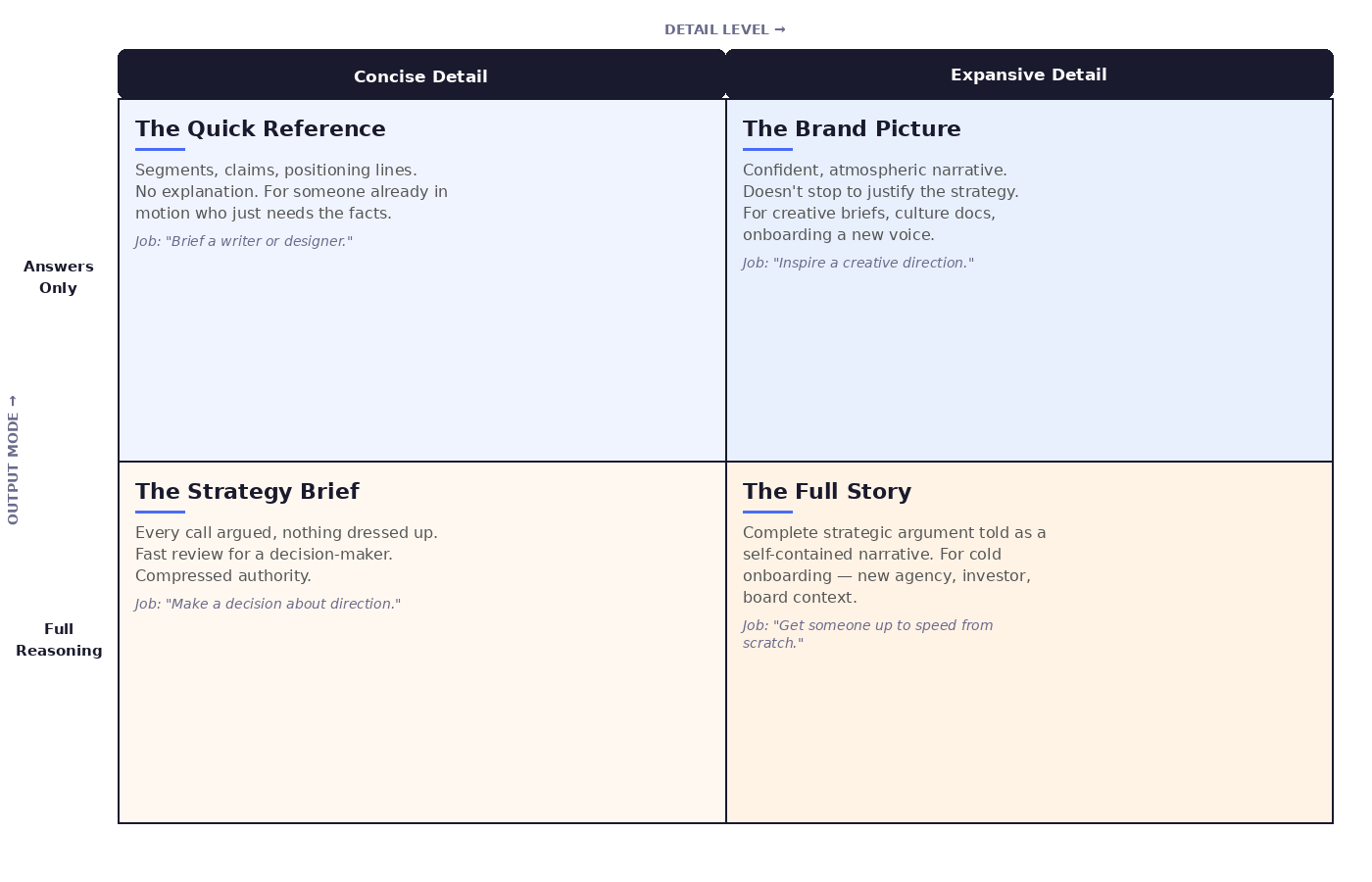
Notice that each corner serves a different audience and a different moment.
The Quick Reference isn’t a worse version of the Full Story. It’s a different tool for a different job.
A head of content doesn’t need a 3,000-word strategic argument to write a social post. A new agency partner walking into the brand cold does.
The Real Question Isn’t “How Long?”
Here’s what we learned that surprised us: when people ask for shorter or longer output, they’re usually not actually asking about length. They’re signaling what they’re going to do next.
• “Give me the short version” usually means, “I already know this brand. I just need the answers so I can get to work.”
• “Give me everything” usually means, “I need to hand this to someone who doesn’t have any context, and it needs to stand on its own.”
That’s not a length preference. It’s a workflow signal.
And it’s the insight behind Ella’s new output controls.
What We’ve Built (and What We Haven’t)
Starting now, you’ll see new Output Sharpening controls in Ella, marked with a beta badge.
They let you shape how your strategy outputs are packaged, based on what you’re going to do with them next.
Under the hood, these map to two dials you’ll see in chat and Playbooks:
• Reasoning — how much of Ella’s thinking is visible
• Verbosity — how much space the ideas get
Together, they let you move between Quick Reference, Strategy Brief, Brand Picture, and Full Story without changing the underlying intelligence.
We want to be clear about what this is and isn’t:
• It’s a shaping tool, not a quality dial. Lower detail doesn’t mean less intelligence. It means the same intelligence, expressed with more confidence and less scaffolding.
• It works best with strategy outputs. Positioning, personas, competitive analysis, brand narratives. For execution-level content like ad copy and email sequences, we’re working on something else — different problem, different controls.
• It’s a Beta. We’re releasing this because we think the direction is right, but we know the details need tuning. We’re watching how you use it, and we want your feedback.
What We’re Learning
We looked at published studies of how people interact with output controls on AI tools, as well as running our own scans of user comments and behavior. A few things stood out that shaped our approach:
• Most people prefer fast. The universally accepted finding is that, given the choice between speed and depth, the majority choose speed for most tasks. That’s why Ella’s defaults are tuned toward confident, efficient output. You can always go deeper when the moment calls for it.
• Short can feel like less. There’s a well-documented tendency to equate longer output with better output. You already know that Distinction requires thinking beyond the average. We’ve designed the compressed modes to feel authoritative, not incomplete. When Ella gives you fewer words, it’s not that she knows less. It’s that she’s trusting you more.
• Most people won’t switch modes often. That’s fine. Ellavator Ai may experiment with setting smarter defaults per play, so the output shape matches the job without you thinking about it. The controls are there when you want to override — not because you need to manage them constantly.
Try It. Tell Us.
This beta is responding directly to feedback you’ve given us about output quality. You asked for more control over how outputs feel and function. This is our first answer.
We don’t think we’ve got it all right yet. That’s why it’s a beta, and that’s why we’re asking you to try it, push it, and tell us what works and what doesn’t. Your feedback will shape what ships next.
• Use the Output Sharpening controls in chat and Playbooks.
• Notice what changes in how your outputs feel and how they work for your team and clients.
• Tell us what you think.
You can share feedback directly through the app, and we may reach out to hear more about your experience.
Your edge is the asset. Ella’s job is to package it in the way that works for the moment you’re in. Now you get a say in how that happens.